Some things never get cleaned up, not because they are especially good at hiding.
They survive because they make too much money.
You may think porn livestreaming is just a woman streaming on her phone while a man hides behind a screen and sends tips. But once you break down the public court cases, it is obvious that the business is not that simple.
It is more like an assembly line that turns vulgarity into a system.
Look at two real cases from court rulings:
A 20-year-old college student surnamed Lin, short on living expenses and wanting a new phone, made 120,000 yuan in one month through illegal adult livestreaming.
A recent graduate surnamed Zhou, tired of slow wages and hard office work, started porn livestreaming with her boyfriend. In half a year, their turnover reached 1.44 million yuan.
The truly frightening part is how fast ordinary people can make money from it.
Short on cash. Sick of work. Wanting quick money. Thinking it is only showing a little. Thinking nobody will recognize you through a screen.
Once people taste that money, it is hard to go back to their old lives.
1 What is it, really?
Porn livestreaming is not really livestreaming.
It is an illegal transaction system dressed up as livestreaming.
A complete chain usually includes several types of players:
The platform operator, which handles the app, website, servers, payment, virtual coins, livestream rooms, and membership system.
Agents and guild leaders, who recruit streamers, bring in users, manage streamer hours, and settle revenue shares.
Streamers, who provide the content, chat with users, and push them to tip. Many are also packaged into specific personas.
Payment and technology providers, who may appear to be simple tool vendors, but if they knowingly support the use case, they can be pulled into criminal risk.
Users, who look like consumers but are often the easiest people to keep harvesting.
In public cases, the way the “Aimeiren” platform operated was typical: the platform recruited guild leaders first, then guild leaders recruited female streamers. After registering as members, users topped up “diamonds” and used virtual gifts to tip. The platform, guild leaders, and female streamers settled shares daily according to fixed ratios.
That is the core business structure of porn livestreaming:
Split one impulse purchase into several layers of headcount-based income.
Users think they are sending gifts to a streamer. The platform sees a cash flow that can be split, repeated, redirected, and harvested again.
2 How does it make money?
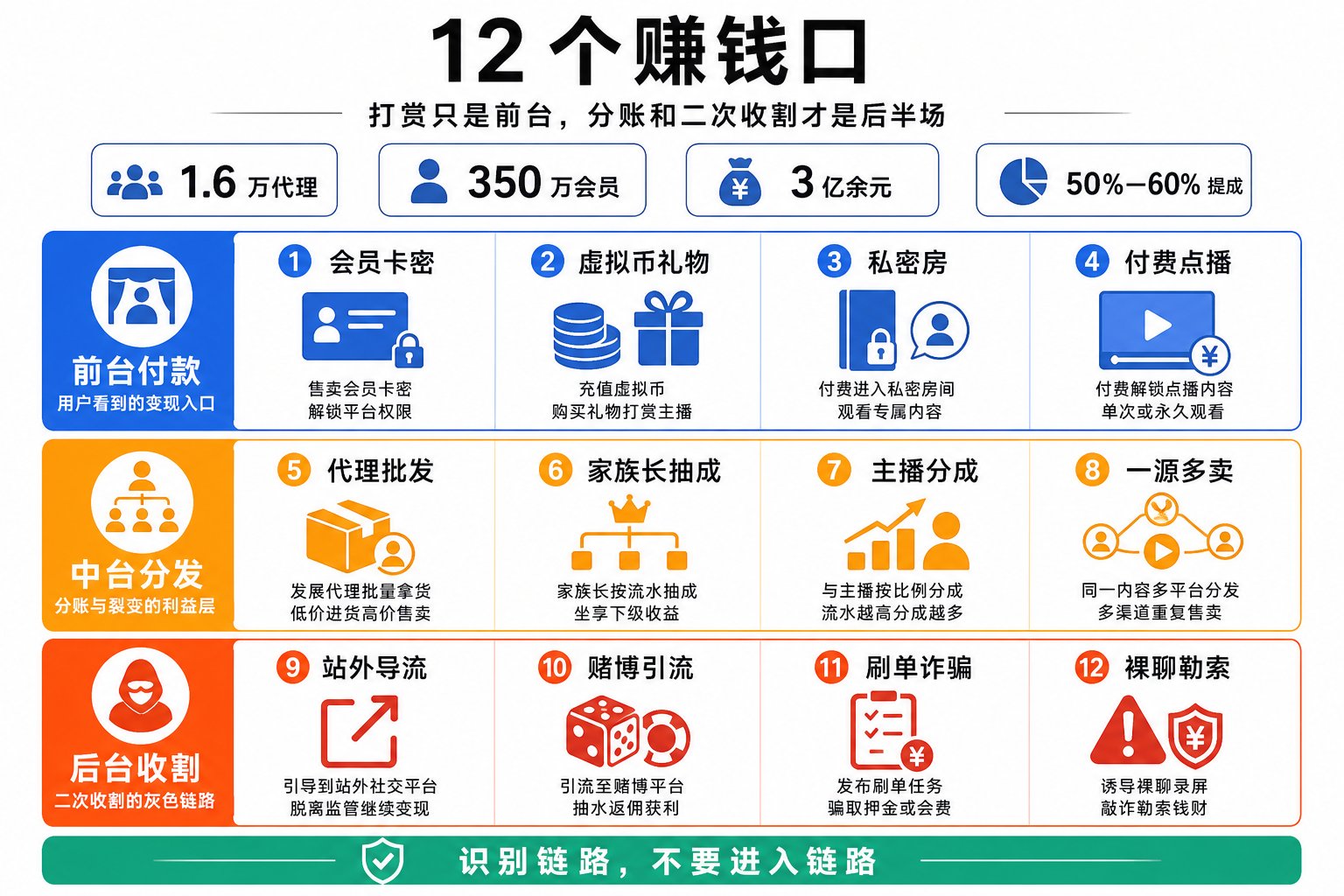
If you only say “it makes money from tips,” you are describing the business too shallowly.
Tips are just the storefront.
The real money comes from the payment gates behind it.
After breaking down public cases, I can see roughly nine payment gates.
2.1 Membership codes: turning porn content into monthly, quarterly, and annual passes
The Max case is the most typical card-code model.
It was not just a livestreaming platform. It was an aggregator app for porn livestreams. A report from the CPPCC Daily, reprinting Procuratorate Daily, described it clearly: “Xiaoqiang Magic Box” started with only livestreaming, then later added cloud playback, movies, and other sections, integrating links to many porn livestreaming platforms and porn websites into its own platform. To use it, users had to register and buy recharge card codes. Those codes were divided into monthly, quarterly, and annual passes, then sold through agents.
That is the first layer of monetization:
Do not produce all the content yourself. Package a pile of porn content into a membership entrance.
The logic is very similar to legitimate video-platform memberships. It is just selling illegal content.
More importantly, Max’s card-code sales were not small. The report said that in the early days, the platform sold around 10,000 monthly passes per month. Later it sold 100,000 per month, and eventually even 200,000 to 300,000 per month. Arrested agents said card-code transactions started at 40,000 to 50,000 yuan per day and later reached 70,000 to 80,000 yuan per day.
This is the harshest part of the card-code model:
Content can be replaced. The app can change its name. Agents can switch accounts. But as long as the card-code system remains, the cash flow keeps running.
2.2 Agent wholesale: the people really getting fat are the ones selling shovels
Many people think the platform only makes money from end users.
Not quite.
It also makes money from agents.
People’s Daily Online’s report on the Max case mentioned that one arrested agent bought card codes wholesale from an upstream seller at a lower price, then marked them up and sold them to lower-level agents. His monthly card-code purchases reached as much as 1.5 million yuan.
That detail matters.
It shows that Max was not simply “selling memberships to viewers.” It was running a multi-level distribution network.
The platform wholesaled card codes to general agents.
General agents sold them to lower-level agents.
Lower-level agents sold them to users.
Every layer took a spread. Every layer had an incentive to keep spreading the business.
So a small ad, a WeChat group link, or a forum post may not be tied to some isolated porn site. Behind it may be a distribution chain of card-code wholesale, agent markup, and end-user consumption.
That is also why Max could grow to more than 16,000 agents, over 3.5 million members, and 250 million yuan in funds involved in such a short time.
The platform does not get rich from one user.
It gets rich by turning every agent into a salesperson.
2.3 Virtual coins and gifts: disguising payment as interaction
Users top up first. The platform turns renminbi into diamonds, tomato coins, gifts, or other virtual items. That step matters because once money becomes in-platform currency, users feel less pain from the real amount.
10 yuan, 50 yuan, 200 yuan become strings of numbers that hurt less.
Why do livestreaming platforms love virtual coins? Because they turn “payment” into “interaction.”
Payment is rational.
Interaction is emotional and addictive.
In the cross-border porn livestreaming platform case cracked by Cangnan police, reports said “tourists” bought “diamonds” through official or individual agents, spent diamonds to enter rooms and watch porn performances, and also bought expensive virtual gifts such as “rockets” to tip streamers.
That is not a simple payment action.
It breaks the transaction into three steps:
First, top up. Money becomes diamonds.
Then enter a room. Diamonds become viewing access.
Then send gifts. Diamonds become emotional interaction.
Each extra layer weakens the user’s sense of real loss.
That is the real value of virtual coins.
They do not make payment easier.
They make it easier for people to lose control.
2.4 Private rooms and paid rooms: turning “one step further” into a paid checkpoint
Some platforms do not make you send gifts forever. They give you a little free content first, then put the real paid content behind memberships, private rooms, and paid viewing.
In the Jiaxing “Max” case, public reports said the platform illegally profited by developing layers of agents and bringing in users to buy membership card codes. These card codes worked like recharge cards. Only after buying them could users enter deeper viewing layers.
Free content is bait.
Membership card codes are the closing mechanism.
The core here is not that the content is sophisticated.
The core is cutting the user’s curiosity into steps.
First layer: free.
Second layer: preview.
Third layer: membership.
Fourth layer: private room.
Fifth layer: one-on-one interaction.
Each time users cross a layer, they have already spent a little money and a little psychological cost.
Once they reach the later layers, they are no longer casual viewers. They are paying users the platform has already filtered out.
2.5 Streamer revenue shares: the platform sells front-end assets that can be mass-produced
Streamers are not the whole platform, but they are the platform’s most important front-end assets.
In the “Tomato Community” case, reports said the platform and streamers split revenue 40/60. In cases reported by People’s Court Daily, there were also structures where platforms and streamers split revenue in ratios around 40/60.
What does this show?
Porn livestreaming platforms do not want one superstar streamer most of all. They want a supply of streamers that can be copied at scale.
If one streamer can make money, the platform will have agents keep recruiting.
If one agent can recruit, the platform will keep giving him a cut.
In the end, it stops being a “livestreaming platform” and becomes a recruitment system.
Look more closely at the Cangnan cross-border porn livestreaming case. Female streamers under guild leaders received 50% to 60% of daily income. The money was first transferred to guild leaders through bank cards, then guild leaders settled shares with the female streamers.
This shows the platform does not directly manage every streamer.
It outsources streamer management to guild leaders.
Guild leaders recruit people, train them, monitor hours, provide scripts, and settle payments.
The platform handles technology, top-ups, traffic, the backend, and revenue splitting.
What does this model resemble most?
An illegal outsourced sales team.
Streamers close deals at the front desk.
Guild leaders manage the team.
The platform runs the cashier.
2.6 Guild-leader cuts: the further upstream you go, the more it looks like a headcount business
The truly powerful part of porn livestreaming platforms is that they let not only streamers make money, but also the people who recruit streamers.
That creates a dangerous incentive:
As long as you can bring in streamers, you can keep taking a cut from their income.
So what guild leaders care about most is often not whether one streamer becomes popular, but whether they can keep expanding the streamer pool.
If one streamer starts making money, she is encouraged to bring in friends.
If one friend joins, classmates, roommates, and hometown acquaintances get pulled in too.
In the end, the chain shifts from “content performance” to “acquaintance recruitment.”
That is also why young women, unemployed women, and cash-strapped students repeatedly appear in public cases.
It is not that they are naturally worse people.
It is that they are easier to hit with the pitch of “high pay, freedom, fast money.”
2.7 Paid on-demand: beyond livestreams, there are secretly filmed videos and inventory content
Porn livestreaming platforms do not necessarily rely only on real-time streams.
The “Huanggua Video” case is another form.
Among the 2021 top ten anti-pornography and anti-illegal-publication cases published by Zhejiang Online, the “Huanggua Video” app had more than 60 million domestic installs and made over 300 million yuan in illegal profit. The chain included overseas R&D and operations teams, domestic video-uploading creators, guild leaders, fourth-party payment-channel gangs, and technical support.
Pay attention to the keywords here:
Video-uploading creators.
Guild leaders.
Fourth-party payment channels.
Technical support.
This shows it was no longer just “streamers go live and viewers tip.”
It mixed paid on-demand, live performances, user uploads, payment settlement, and technical operations into one business.
For the platform, livestreaming is instant stimulation. On-demand content is inventory.
Livestreaming gets people worked up.
On-demand lets the same content make money again and again.
2.8 One source, many sales: pushing the same content across multiple apps and websites
The Cangnan cross-border porn livestreaming case has another detail worth spelling out.
Police found that the livestreaming platform shared the same video sources with multiple obscene websites and livestreaming platforms inside and outside China. In other words, users could see the same livestream content across multiple apps and websites, while the operator behind them was the same criminal gang.
That is “one source, many sales.”
The same streamer.
The same livestream.
The same batch of content.
Change a few app names, change a few website entrances, change a few sets of promotional copy, and it can be sold to different traffic pools.
That is also why some porn sites look wildly different on the surface, while the same group may be behind them.
Many front desks.
One backend.
This is the biggest difference between a digital brothel and a traditional porn venue:
A traditional venue has limited space.
A digital venue can clone its entrances without limit.
2.9 Reselling porn traffic: gambling, fake-order scams, and nude-chat extortion are the second half
The dirtiest money in porn livestreaming is often not in the first tip.
It is in resale.
Legal Daily reported a case in which “porn livestreaming hid gambling gangs”: porn livestreams became a traffic funnel for overseas gambling and money-laundering groups. The chain included livestreaming platforms, gambling platforms, fourth-party payment platforms, phone-bill top-ups, SMS-code receiving, and other links.
The Beijing News also investigated similar “online pornography” traps: criminals posted porn ads through porn websites, social apps, video apps, text messages, and other channels. They used porn videos and “free hookups” as bait, pushed victims to download apps, then made them perform “tasks” such as fake orders, investment, or gambling. At first they gave small rebates. Later they used excuses such as system errors, data errors, and operational mistakes to make victims keep putting in money.
This is the cruel second half of porn livestreaming traffic:
Step one: use porn to filter out people who are easy to excite.
Step two: use interaction to filter out people willing to pay.
Step three: use off-platform apps to filter out people willing to keep believing.
Step four: send those people into gambling, fake-order scams, and nude-chat extortion.
So a lot of the time, the platform does not care whether you become a long-term user.
It only needs to confirm one thing:
Are you easy to lead around by desire?
If the answer is yes, you will be sent into the next, more expensive chain.
2.10 Contracts and arbitration: even streamers can become a revenue source
There is another money gate people often overlook: the streamers themselves.
Beijing Daily, citing Procuratorate Daily, reported that some livestreaming guilds use slogans like “high pay” and “comfortable work” to attract people. After signing them, they provide no support and even require streamers to do porn streams or gambling streams. Some guilds also plant traps in contracts through resignation restrictions, exclusivity clauses, and huge breach-of-contract penalties, then use arbitration or lawsuits to profit from streamers.
Put this next to the porn livestreaming black market, and the irony is obvious.
Streamers think they are there to make money.
In reality, they may be harvested by the platform, guild leaders, users, and contracts at the same time.
The front end harvests viewers.
The backend harvests streamers.
That is the real structure of the “digital brothel.”
It is not a one-way exploitation system.
It is a multi-directional extraction machine.
2.11 Agent distribution
Agents are the most dangerous layer of these platforms.
What ordinary people see is a link, a QR code, an avatar, or a vague line of copy.
What the platform sees is a low-cost distribution network.
In the Jiaxing “Max” case, the platform developed more than 16,000 agents. After the first police crackdown, the platform continued recruiting agents and promoting related apps on WeChat, QQ, Weibo, and other social platforms.
That is why it is so hard to kill in one strike.
The platform can shut down.
Agents can switch accounts.
Links can change shells.
User traffic keeps moving in the dark.
2.12 Off-platform diversion
This layer is the easiest to underestimate.
Many porn livestreaming platforms are not satisfied with tips. They also divert users off-platform to social apps, private groups, gambling sites, scam apps, and nude-chat extortion.
CCTV’s report on the “Max” case said the platform colluded with gambling gangs and used porn traffic to promote gambling websites.
Douyin’s 2025 enforcement cases also mentioned black-market groups buying and registering accounts in bulk, changing avatars to contain vague contact information for third-party platforms, and guiding users to download illegal porn-related apps. Other gangs used “offline prostitution” as bait to induce users to spend and tip; multiple people were eventually criminally detained.
So a lot of the time, it is not trying to make those few dozen yuan from your tip.
It is trying to test whether you are the kind of person who loses control easily.
If a porn link can pull you away, gambling, nude chat, and fake romance may pull you away again.
That is the “user profile” in the eyes of the black market.
3 How terrifying are the profits? Do the risk math
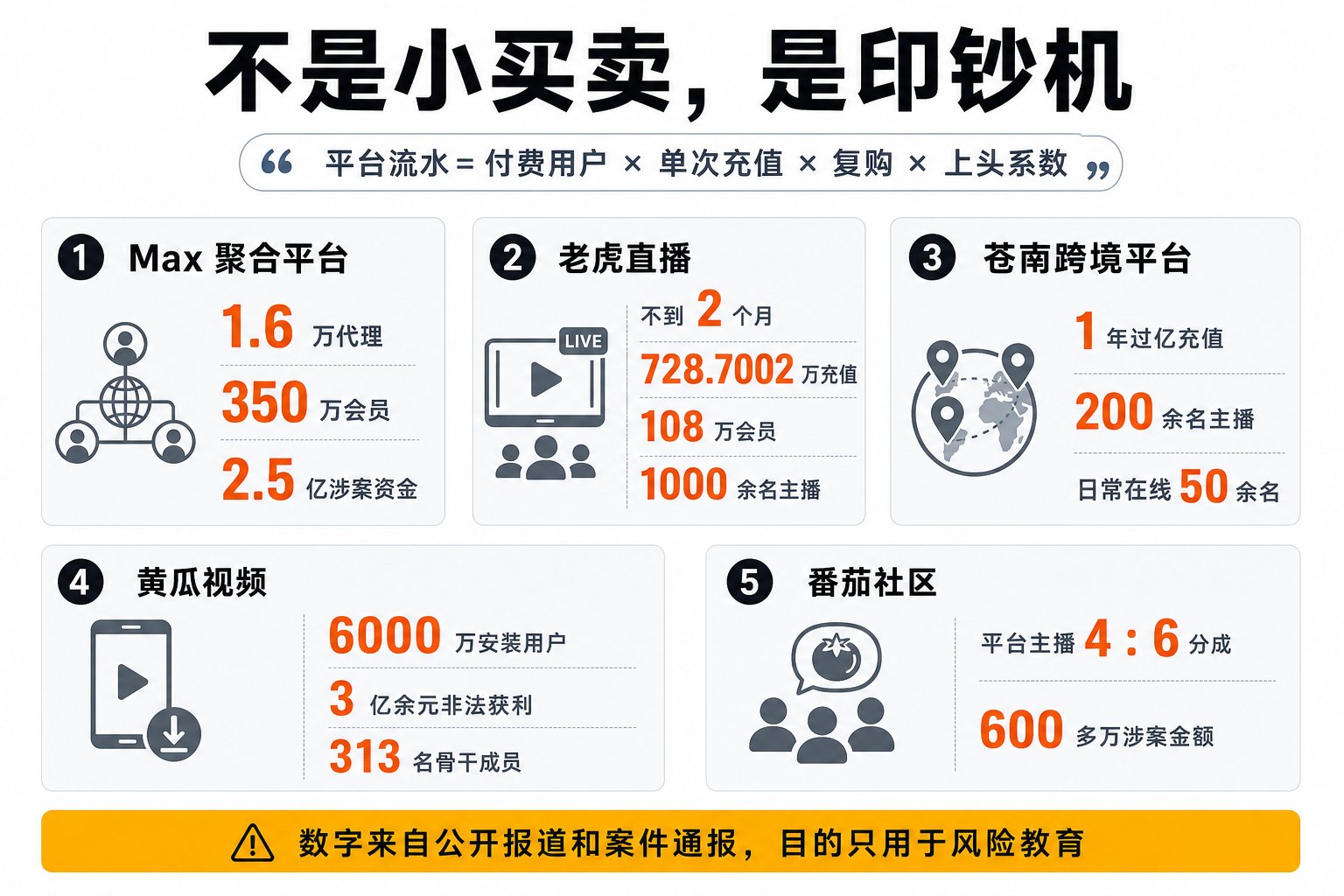
I will not write an operating ledger here. Only a risk ledger.
Because this is not a project tutorial. It is a breakdown of a criminal chain.
Start with the change in industry scale.
A video script gave one set of figures: from 2020 to 2025, the number of adult livestreaming platforms rose rapidly from 300 to 500 platforms to 3,000 to 5,000 platforms. The industry’s annual transaction volume rose from 10 billion yuan to 80 billion yuan.
Seen alone, those numbers sound exaggerated.
But when placed next to public cases, they become easier to understand.
Jiaxing “Max” case: more than 3.5 million members, over 16,000 agents, and 250 million yuan in funds involved.
“Tiger Live” case: the platform ran for less than two months, with cumulative top-ups of 7.287002 million yuan, more than 1.08 million registered members, and over 1,000 female porn streamers.
“Tomato Community” case: platform and streamers split revenue 40/60, with more than 6 million yuan involved.
Overseas-platform case reported by People’s Court Daily: total fines of 7.04 million yuan, 3.18 million yuan in criminal proceeds recovered, 4.16 million yuan in illegal gains surrendered, and 890,000 yuan in bank deposits frozen.
Cangnan cross-border porn livestreaming case: one platform reached more than 100 million yuan in top-ups in a year, had over one million registered members, recruited more than 200 female streamers, and had more than 50 streamers online on a typical day.
“Huanggua Video” app case: more than 60 million domestic installs, over 300 million yuan in illegal profit, and a chain that included upload creators, guild leaders, fourth-party payment-channel gangs, and technical support.
The script also mentioned a smaller-grain account: building a small livestreaming platform may require only 5,000 to 10,000 yuan in input, but monthly turnover can reach 100,000 to 500,000 yuan.
The educational value of these numbers is not that they tell you how profitable this is.
It is that they tell you why it will not die.
If an illegal platform required millions in startup costs, one takedown would break its bones.
But if startup costs are low, shell-switching costs are low, agents can reorganize, and users can be redirected, it grows back like weeds.
That is not vitality.
That is the cost of crime being too low.
Behind these numbers is a formula:
Platform turnover ≈ number of paying users × single top-up amount × repeat-purchase frequency × emotional-overheating coefficient
The real variables are not in “content quality.” They are in three places:
First, can users be pulled in quickly?
Second, can users be kept inside paid scenarios?
Third, can users be repeatedly stimulated into spending?
That is also why regulators keep focusing on “vulgar inducement to tip,” “fake personas used to trick users into tipping,” and “stimulating irrational tipping.” The Cyberspace Administration of China’s 2025 “Qinglang” special campaign against livestream tipping chaos explicitly named these problems, including vulgar group livestreaming, fake personas, inducing minors to tip, and PK mechanisms that stimulate irrational tipping.
Porn livestreaming only pushes the same mechanism into a dirtier, more illegal, and more dangerous place.
In legitimate livestreaming, inducing tips is already a governance priority.
In illegal livestreaming, inducing tips is just the entry fee.
4 Common tricks in the industry
What porn livestreaming platforms exploit best is not technical loopholes.
It is human weakness.
4.1 Free first, paid later
They let users see a little first, then tell them the rest requires a top-up.
This is not a content strategy. It is a psychological noose.
In public cases, “Tomato Community” provided some free videos every day. To keep watching other content or livestream performances, users had to buy virtual coins and tip.
Free is not kindness.
Free lowers the psychological cost of the first click.
4.2 Normal first, upgraded later
Many livestream rooms do not start with explicit content. They first use ordinary chatting, flirtatious interaction, and lowbrow borderline content to keep people there.
Once people stay, they start investing time.
After investing time, they are more likely to invest money.
4.3 Persona first, harvest later
The strongest part of livestream tipping has never been just the image.
It is the persona.
You think you are watching content. In reality, you are interacting with a designed object.
“Pitiful,” “innocent,” “needs support,” “treats only you as special” — once these things are layered with sexual suggestion, consumption can easily be disguised as a relationship.
The Cyberspace Administration’s 2025 special campaign also listed “fake personas used to trick users into tipping” as a key target, including fabricating family misfortune, impersonating specific identities, and using AI to generate fake content.
The porn livestreaming black market uses this even more aggressively.
Because it never planned to build trust for the long term. It only planned to harvest in the short term.
4.4 On-platform first, off-platform later
Inside a platform, there is at least some review and some record.
Once you are led off-platform, the risk starts rising exponentially.
Nude-chat scams, gambling diversion, fake romance, extortion, and threats often happen off-platform.
You think you only added a contact.
The black market sees that you have stepped outside the platform’s protected zone.
5 A field guide to spotting the black-market chain
Many people have a misconception when looking at the porn livestreaming black market:
They think everything is fine as long as they do not click especially explicit links.
Wrong.
A mature black market does not write the word “illegal” on its face from the start.
It disguises itself as part-time work, dating, side hustles, paid chatting, emotional counseling, livestream training, online work, or even a content account that looks completely normal.
To identify it, do not only look at what it says.
Look at where it wants to take you.
5.1 Recruitment: it will not say “come break the law.” It will say “easy money.”
When recruiting streamers, the black market’s most common packaging is not pornography. It is “low barrier, high income.”
It hides the risk and shows only the returns.
There are several common shells.
The first is the part-time-job shell.
The pitch usually revolves around “work from home,” “flexible hours,” “no need to show your face,” “make money just by chatting,” “a nice voice is enough,” and “newcomers get guidance.”
The most dangerous part of this pitch is that it packages a high-risk act as an ordinary part-time job.
Many young people do not start out aiming to break the law. They start with “I need money,” “I want to buy a phone,” “I want to repay Huabei,” or “I want some living expenses.”
That is where the real problem lies:
The more a part-time job emphasizes “easy, high-paying, no experience required,” the more you should ask: where exactly does the money come from?
The second is the livestream-training shell.
It will not tell you directly what to do. It first asks you to join a group, listen to a class, and look at screenshots of earnings.
The screenshots always show how many gifts someone received today, how much they withdrew yesterday, and how much turnover they made this month.
It is not selling a method.
It is selling the illusion of “you can do this too.”
The third is the acquaintance-referral shell.
In public cases, agents, guild leaders, and streamers often have recruitment relationships. Referrals by acquaintances lower people’s guard most easily, especially when the person is a classmate, roommate, senior schoolmate, or friend.
The more it comes through an acquaintance, the more clearly you need to calculate the incentives:
Why is she recruiting you?
Does she take a cut from you?
Why is the thing she wants you to do not something she dares put in a proper contract?
5.2 Traffic diversion: its biggest fear is that you stay on a legitimate platform
The core move in a porn livestreaming chain is always to take people away from legitimate platforms.
So when identifying diversion, do not only watch for sexual terms.
A lot of diversion is not explicit at all.
It may be tiny text in an avatar, a homophone in a bio, a code word in the comments, a screenshot in a DM, or contact information flashing in the livestream background.
It may also start with a seemingly normal chat:
“It’s not convenient to say here.”
“The platform is strict.”
“Go over there for the full version.”
“Add me and I’ll send you benefits.”
“Download this. That’s where the good stuff is.”
What these lines have in common is not pornography.
It is that they make you leave the original platform.
As long as the other person’s core action is making you download an unfamiliar app, join an unfamiliar group, add an unfamiliar contact, scan an unfamiliar code, or click an unfamiliar short link, this is no longer ordinary content consumption.
You are being transferred.
5.3 Payment: it will not make you feel like you are spending money. It will make you feel like you are interacting
The smartest part of porn livestreaming platforms is that they rarely let you directly feel, “I spent this much money.”
They turn money into virtual coins, gifts, memberships, room cards, card codes, levels, and intimacy scores.
That step matters.
Renminbi is real.
Virtual coins are numbing.
You may hesitate before tipping 199 yuan, but swiping a gift, opening a room, or renewing a membership feels much lighter psychologically.
It also uses several things to push you to keep spending:
First, time limits.
The stream is about to end, last show, only today’s viewers can see this.
Second, rankings.
Top supporter, guardian, fan badge, intimacy value.
Third, a sense of exclusivity.
“Only for you,” “you’re different from everyone else,” “tip a little more and I’ll…”
Fourth, sunk cost.
You already topped up, so not continuing would be a loss. You already reached this level, so stopping now wastes everything.
That is why many people start by wanting to spend only a few dozen yuan and then sink deeper and deeper.
They did not suddenly become stupid.
They were led step by step into a consumption environment designed to weaken rationality.
5.4 Control: the most valuable thing is not your money. It is leverage over you
The porn livestreaming black market rarely stops at one transaction.
For users, off-platform chats, nude chats, transfer records, download records, contact-list permissions, phone albums, and self-shot videos may all become material for later threats.
For streamers, recorded livestreams, identity documents, payment flows, chat records, and acquaintance relationships can also become control material.
That is why “I’ll just try it once” is especially dangerous.
The black market loves “just trying it once.”
Because once you try it, it has a chance to leave a record.
Once there is a record, the relationship changes.
You think you still have choices. The other side knows you are starting to feel afraid.
Many extortion schemes do not win through technology. They win through psychology.
They may not really have all your information. They only need to make you believe they might.
Once you panic, you are more likely to keep paying.
5.5 Laundering the image: it does not necessarily stay in the gutter forever
More troublesome is that some black-market operators do not stay underground forever.
After making their first pot of money, or after being hit by platform enforcement, they may move onto legitimate platforms and launder their image.
The methods are not complicated:
They do not mention past illegal traces. They only say they “understand human nature,” “understand traffic,” “understand livestreaming,” and “understand emotional value.”
They do not mention black-market experience. They package it as “operations methodology,” “private-domain conversion,” “livestream training,” and “emotional counseling.”
They do not mention old agent chains. They show luxury cars, transfers, travel, and an entrepreneur persona.
The most dangerous part of these accounts is that they package bad outcomes as success studies.
They do not tell you why others were sentenced, how many people were scammed, or how many young people were dragged down.
They only tell you:
Look, I made money.
That is the most poisonous part.
They are not talking about making money.
They are deleting the cost of breaking the law from the story.
5.6 Getting out: once something feels wrong, the most important thing is to stop handing things over
If you are a viewer and find that you have already been diverted, charged, or threatened, the first thing to do is not keep explaining or keep begging the other side to delete records.
The first thing is to stop giving money, stop sending material, and stop proving yourself.
Save chat records, transfer records, screenshots of links, and account information. Then report it to the platform and call the police if necessary.
If you are a recruited streamer and find that the content you are being asked to do has crossed the line, do not believe lines like “everyone does this,” “the platform is overseas so it is fine,” or “if you do not show your face, nobody will know.”
Those words are not protecting you.
They are lowering your determination to leave.
What actually protects you is stopping participation immediately, preserving evidence, and cutting contact with agents, guild leaders, and platform operators.
If you are a parent and find unfamiliar livestreaming apps, abnormal top-ups, late-night private chats, unfamiliar groups, or flirtatious language on your child’s phone, do not make scolding your first reaction.
Stop the money and accounts first.
Then ask clearly about the chain: who introduced it? What was downloaded? How much was topped up? Were photos, videos, or identity information sent? Was there any threat?
The most useless move here is moral judgment.
The most useful move is cutting off the loss.
6 What role does AI play here?
One judgment in the video script is right:
AI did not automatically make the world cleaner.
It only lowered the cost of disguise.
In this kind of porn livestreaming industry, AI mainly does three things.
6.1 Lowering the “beauty cost”
In the past, platforms needed real streamers’ looks, bodies, and voices to attract users. Now beautification filters, face swapping, voice changing, and virtual avatars can all be used as disguise.
This means platforms do not necessarily need to find “high-attractiveness streamers.” They only need to find people willing to cooperate, then use technology to package the front end.
The video script put it bluntly: AI beautification can raise tip rates by three to five times and double average order value.
No matter how much those numbers fluctuate across platforms, the direction is clear:
AI here is not improving aesthetics.
AI is increasing the impulse to pay.
This creates a dangerous illusion:
Users think they are looking at a person.
They are actually looking at a packaged product.
6.2 Lowering the feeling of identity exposure
For streamers, face swapping, beautification, and virtual avatars lower the psychological barrier.
“Anyway, that is not what I really look like.”
That sentence sounds like protection. In reality, it may be a trap.
Because the platform has recordings, agents have chat logs, payments leave transaction flows, and users may screen-record. You think AI has separated you from your real identity. In the end, it may only help you step into risk faster.
6.3 Making scams more realistic
AI face swapping, voice cloning, and virtual personas make fake interaction feel more real.
The Cyberspace Administration’s 2025 “Qinglang” special campaign against the misuse of AI technology explicitly listed AI face and voice cloning that infringes public rights, missing AI-content labels that mislead the public, and other issues as key targets. In the first phase, regulators handled more than 3,500 noncompliant AI products and removed over 960,000 pieces of illegal or noncompliant information.
This shows regulators have already seen the trend.
Once AI combines with pornography, scams, and tipping, the most dangerous question is not “does it look real enough?”
It is “does the user still know what they are interacting with?”
If they do not know, they lose control.
7 Why is it so hard to wipe out completely?
Many people ask:
If this is so illegal, why does it keep coming back?
The answer is not that regulators are ignoring it.
The answer is that this business has several classic black-market traits.
7.1 Asset-light
It does not need storefronts, stable locations, or a large offline organization.
One app, a set of payment entrances, a group of agents, and a pile of accounts are enough to start moving.
That is also why it often changes shells.
“Sleeping Beauty,” “Ambiguous,” “Meiniang,” and “Aimeiren” all appeared in public cases as platform aliases repeatedly changed by the same operator.
7.2 Distributed
The platform operator, agents, streamers, payment providers, and users do not have to be in the same place.
In the Jiaxing “Max” case, overseas organizers, domestic agents, social-platform promotion, and gambling diversion were mixed together. Police went to Cambodia twice to arrest organizers, while also arresting large numbers of agents inside China.
This is not a single point.
It is a web.
7.3 Stable demand
Pornography, companionship, stimulation, curiosity, loneliness — these demands do not disappear because one platform is taken down.
The platform dies. The demand remains.
If the demand remains, someone will keep changing shells.
What the black market fears most is not one app being banned.
It fears users no longer taking the bait.
7.4 Entangled boundaries with legitimate platforms
Many black-market operators no longer put illegal content on legitimate platforms from the start.
They first use borderline content, attractive avatars, vague bios, and private-message scripts to pull people away from legitimate platforms.
In Douyin’s 2025 published data, 88,000 person-times were penalized for vulgar inducement to tip, and 117,000 porn-related violating accounts had livestreaming privileges permanently revoked. Leads involving porn-app diversion and offline-prostitution tipping inducement were also transferred to police, with criminal detentions following.
This shows legitimate platforms are being used as traffic entrances for the black market.
Not every borderline account leads to porn livestreaming.
But many porn livestreaming chains start with borderline content.
7.5 Short life cycles, which make short-term harvesting even more aggressive
The video script also made one judgment: small illegal adult livestreaming platforms may last only 45 days on average, while mid-sized and large platforms often have survival windows of only several months.
If that number holds, it explains many behaviors that look abnormal.
Why does it not care about user experience?
Because it never planned to serve you long term.
Why does its script become more aggressive?
Because it wants to push turnover before getting shut down.
Why does it divert users off-platform into gambling and nude-chat scams without hesitation?
Because it knew from day one that this was a disposable business.
Legitimate platforms talk about retention.
Black-market platforms talk about squeezing people dry.
8 Risks worse than losing money
For ordinary people, the biggest loss from porn livestreaming is not necessarily money.
It is not knowing what you have already handed over.
8.1 Viewer risks
The first layer is money.
Top-ups, tips, memberships, private rooms, and off-platform payments are all money.
The second layer is privacy.
What apps you downloaded, what accounts you registered, whom you transferred money to, and what you chatted about can all become material for threats.
The third layer is fraud.
Nude chat, gambling, fake orders, fake romance, offline meetups — any step can turn from “consumption” into “extortion.”
The fourth layer is legal and family risk.
Once it involves distribution, organization, recruitment, agency work, or helping promote, it is no longer “I was just watching.”
8.2 Streamer risks
Many people think streamers are just “making quick money.”
Public cases tell you otherwise.
In cases reported by People’s Court Daily, multiple streamers were sentenced to prison terms ranging from four years to seven years and two months, and were fined.
This is not moral risk.
It is criminal risk.
More realistically, once someone enters this chain, they are often controlled from multiple sides: platforms, agents, acquaintances, and users.
Screen recordings, chat logs, transfer records, and identity information can all become ropes used to control you later.
You think you are making money.
Many times, you are giving other people leverage over you.
8.3 Risks to minors
Minors are the people who least belong in this chain and the easiest to harm.
In 2022, four departments issued the Opinions on Regulating Online Livestream Tipping and Strengthening the Protection of Minors. It clearly required banning cash top-ups, gift purchases, online payments, and other tipping services for minors. It also required canceling tipping leaderboards and forbidding platforms from using tipping amounts as the sole basis for streamer rankings, traffic allocation, or recommendations.
Why so strict?
Because tipping mechanisms amplify impulse by design.
Adults may not withstand them. Minors are even less able to.
Add pornography, companionship, and fake relationships on top, and this is no longer an entertainment problem. It is a harm problem.
9 A survival guide for ordinary people
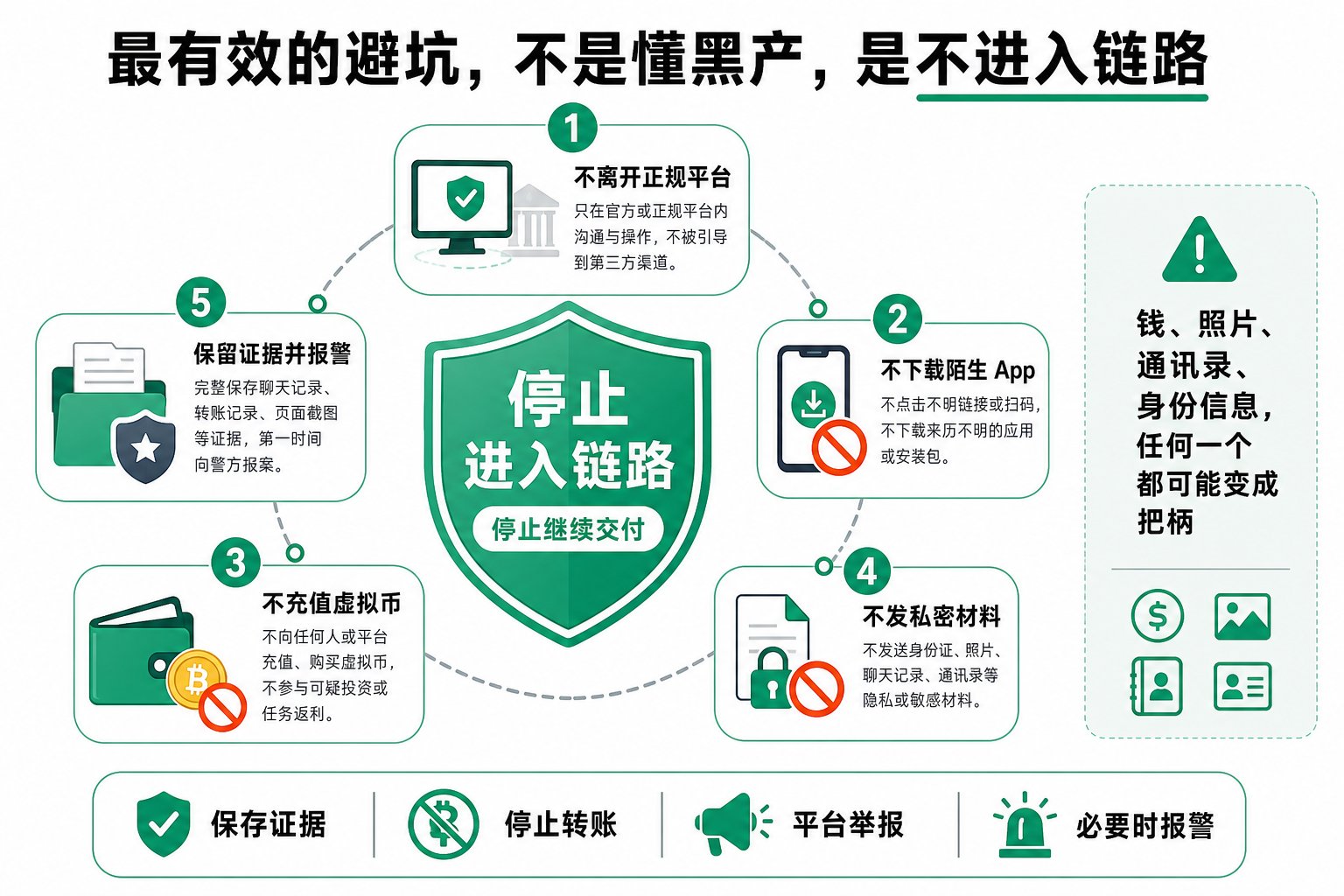
9.1 Anything that guides you away from a legitimate platform should be treated as risky by default
Avatars, bios, comment sections, private messages, livestream backgrounds, homophonic code words — if the core action is pushing you to another platform, making you download an unfamiliar app, or getting you to add an unfamiliar contact, stop first.
The real danger is not what you clicked.
It is that you started walking the path someone else laid out for you.
9.2 Anything that makes you top up first before unlocking access should be avoided
Especially unfamiliar apps, websites, private rooms, membership cards, and virtual coins.
These platforms are best at turning real money into virtual chips, making you feel less loss.
You are not consuming content.
You are sending yourself into the other side’s harvesting system.
9.3 Anything involving nude chat, recordings, or private photos should be cut off immediately
Do not explain. Do not bargain. Do not keep proving who you are.
Save evidence, stop communicating, and report it to the police or the platform.
A lot of extortion works because you panic.
The more you want to settle it privately, the more the other side knows you are afraid.
9.4 Parents should not only watch “what the child saw.” Watch where the money went
When minors are harmed, it often starts not with content, but with payment.
Parents should look beyond “did my child see borderline content?”
More important: are there unfamiliar top-up records, abnormal transfers, sudden downloads of unfamiliar apps, or frequent late-night chats?
The path of money is often more honest than browsing history.
9.5 Do not treat “everyone is watching” as proof of safety
The black market loves manufacturing atmosphere.
Online viewer counts, bullet comments, gift effects, leaderboards, top-up rebates, and streamers thanking users are all designed to make the whole thing feel normal.
The more it looks like a lively venue, the more you should ask:
Why is it trying to make me pay so quickly?
Conclusion
The real money in porn livestreaming does not come from porn content itself.
Content is only the entrance.
The real money is in the chain behind the entrance:
Traffic, top-ups, tips, revenue shares, agents, off-platform diversion, and scam filtering.
That is why it is so hard to kill with one punch.
Take down one platform, and it changes shells.
Ban one account, and it switches accounts.
Clean up one batch of livestream rooms, and it moves into private domains.
The harshest part of this business is that it makes people think they are only watching from the sidelines.
In reality, from the first click, the sickle is already starting to move.
Comments