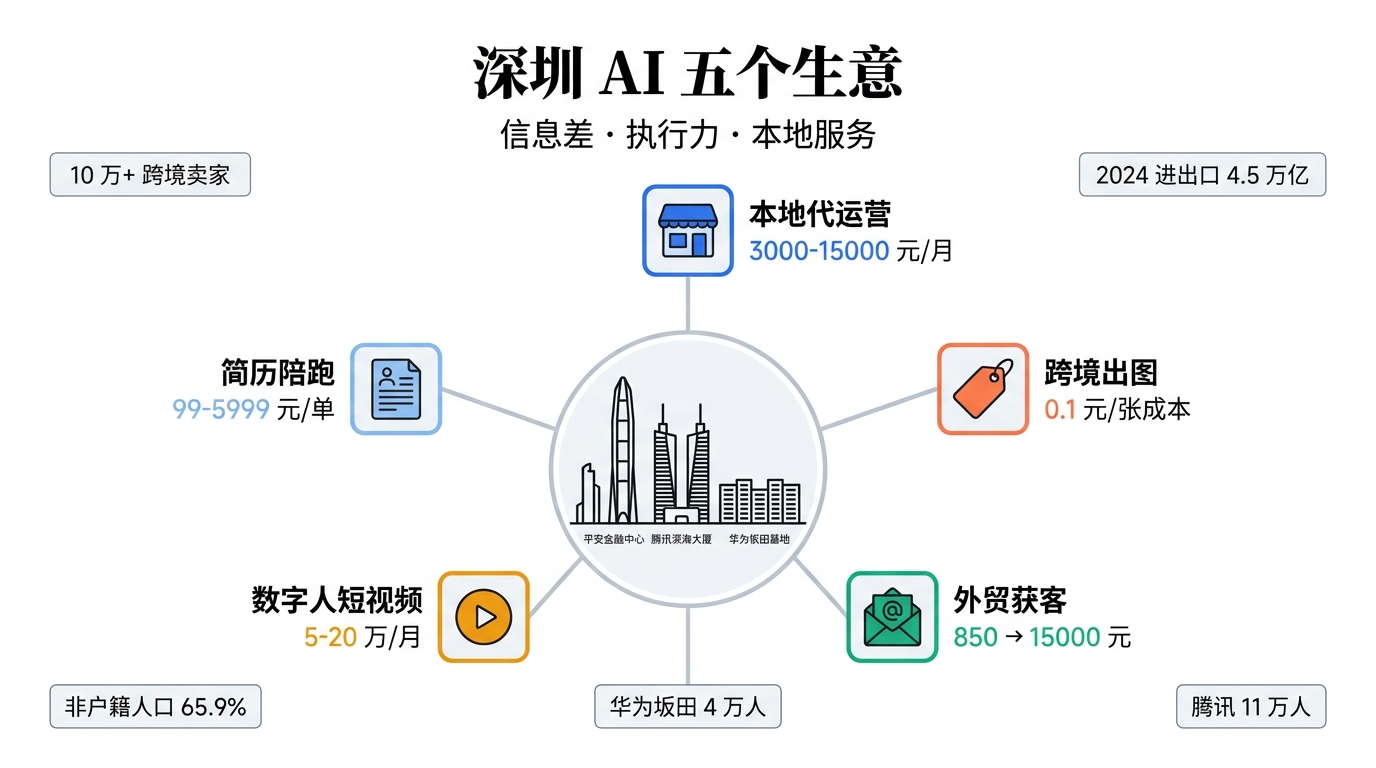
Why Shenzhen?
Because Shenzhen is at the same time China’s cross-border e-commerce capital (number one on Amazon’s global city ranking, with 100,000+ sellers concentrated here), the country’s number-one foreign-trade city (4.5 trillion RMB in imports and exports in 2024, leading the nation 32 years running), the southern stronghold of the big internet companies (Tencent with 110,000 staff, Huawei’s Bantian campus with 40,000), and one of the densest cities in China for restaurants and medical aesthetics (Futian CBD does 3 billion RMB in retail sales per square kilometer, and Nanshan has more medical-aesthetics clinics than any other district nationwide).
That means the bosses and workers you’d serve in all five of these businesses are stacked right around you, and people here only care about one thing — making money.
Selling services to ordinary people is hard. Selling to people who want to make money is easy — as long as your return beats their cost, you close the deal.
The five businesses below share one thing in common: any ordinary person can do them. No tech background, no capital, no team. Just use AI to multiply what one person can output, then sell that output to the anxious small-business owners who can’t use AI and to the anxious workers themselves.
I’ll break each one down four ways: how you make money, where the profit lives, what the barrier is, and how an ordinary person actually starts.
1. AI-Powered Operations for Local Merchants
Bosses aren’t paying for AI. They’re paying for foot traffic.
Shenzhen restaurant growth in 2024 was a sad 1.3% — far below the national 7.9%. First-tier cities see 10–15% of restaurants close every month. Futian CBD pulls 2 million daily foot traffic, did 241.4 billion RMB in retail (third-highest district in China), and gets over 60% of its consumption at night — and stores in Futian still die. Nanshan opened 170 flagship restaurants in three years; most didn’t survive two.
What keeps this crowd of restaurant owners, nail salons, medical aesthetics clinics, pet shops, and gym operators awake at night is one sentence: “Revenue dropped again this week.” They don’t have time to study AI. They don’t care which model you use. They care about exactly one thing: can you bring customers through my door?
The operations business is just selling foot traffic to bosses.
How you make money
You handle everything for the boss on Douyin, Xiaohongshu, Video Account (WeChat Channels), and WeChat groups. Monthly delivery looks like this: 3–5 short videos a day (AI-written scripts, AI voiceover, Jianying (CapCut) edits), 1–2 live streams a week, comment and DM replies, plus funneling walk-in customers onto WeChat and into the boss’s own WeChat group. The whole “add WeChat + group management + repeat purchases from old customers” play has its own name in the trade — “private traffic.”
The boss pays ¥3,000–5,000/month, 12-month contract.
One person doesn’t run one store. AI multiplies single-person output by 5–10x, so you can run 8–15 stores at the same time.
Where the profit lives
Going by published market rates:
- Douyin local-account operations: ¥3,000–5,000/month (industry baseline)
- Short-video package (20–30 videos/month): ¥5,000–8,000/month
- Full technical management: ¥8,000–15,000/month
- Full Douyin Enterprise Account management (live streams + ad spend included): around ¥80,000/month (ceiling)
Costs: one computer, one person, a few tool subscriptions. Total annual cost under ¥5,000.
Shenzhen per-capita disposable income is 81,123 RMB, almost 2x the national average. Bosses here are several notches more willing to “pay for traffic” than bosses inland. A freelancer running 8 clients can clear ¥20,000+ a month without breaking a sweat. The single-person ceiling is 15–25 clients.
What the barrier is
You need a little Jianying (CapCut), a little Douyin and Xiaohongshu posting, the ability to follow what a boss actually says (you have to tell the difference between a beauty boss’s pain points and a restaurant boss’s pain points), and the willingness to go offline (your first 3 clients basically come from door-to-door visits and showing your face in boss WeChat groups).
You don’t need any tech, capital, team, or business license.
Who fits: your mom ran a nail salon in the neighborhood, your dad ran a BBQ stall, you used to work as a medical-aesthetics consultant. People who already speak the insider lingo of local small bosses are the fastest to get traction. Another Shenzhen advantage: 65.9% of residents aren’t local hukou holders, and roughly 4 million Hunan natives live in Shenzhen — fellow-provincial boss circles are a built-in trust channel.
Who shouldn’t touch this: pure internet people who’ve never dealt with an offline business and only talk to code. These bosses trust people they’ve sat across from in person — not people who DM them PDFs.
How an ordinary person starts
Xiaoshi, a hairstylist from a third-tier city in Sichuan, started livestreaming in her sixth month after opening. In 20 days she sold ¥580,000 in hair packages by herself, with an 82% redemption rate. Lao Shen in Shanghai opened a home-decor operations shop in 2024. His first job was a villa sauna room. His first video pulled in ¥50,000 in sales, and within a week his second hit ¥150,000+.
The pattern here is “boss anxiety + industrialized content services.” Shenzhen has dozens of times the density of Sichuan, so this is even more repeatable.
- Pick an industry you actually understand. Lanes worth picking in Shenzhen: Nanshan medical aesthetics (340 clinics, first among all Chinese districts), Futian restaurants (top 3 nationwide on the Must-Eat list), Luohu Dongmen beauty, education and training near Bantian’s single-occupant apartments in Longgang, pets in Bao’an. Pick one and go.
- Find your first client. Type “Shenzhen restaurant boss Douyin customer acquisition” into Douyin’s search bar, click the “users” tab, and look for verified enterprise accounts running group-buying links with a lot of “where’s the address” comments. The algorithm already filtered them for you. Shenzhen’s store-探店 activity ties with Guangzhou and Chongqing for top 3 nationally — almost every merchant has a live presence on Douyin.
- Keep your first DM under 100 characters. “I saw your group-buying post for your X Road location. I’ve done [data] for the same category. Is what bothers you most ticket size or footfall?” Don’t lead with a WeChat QR code.
- First job free. Pick one nearby shop you can visit daily, run it for 30 straight days, and screenshot every metric — footfall, DMs, group-buy redemptions.
- Build a case deck. Picture-heavy PDF, with the data on page one. Then float in local restaurant boss groups, beauty boss groups, and chamber-of-commerce groups. Hand out cases, not business cards.
- Price and sign. First 3 clients at cost — ¥2,000–3,000/month. From client #4 on, you charge the industry rate, ¥3,000–5,000/month. Shenzhen bosses are better at paying than inland bosses, but pin four things into the contract: monthly payment + monthly review, no serving competitors, who covers third-party fees, and what plan B looks like.
- The week you land your first hit, raise the price or expand the SKU. Lao Shen’s window between his first ¥50,000 video and his ¥150,000+ video a week later is exactly the renewal-negotiation moment. Either bump the price, or expand from short videos to “short videos + live + WeChat group” full package.
- Run an account matrix to dominate search. Aqiang in a second-tier city took 70% of the local “whole-house renovation” search results with his own accounts, generating 400 leads in one month. Run four account types in parallel: amateur recommender, marketing account, designer IP, sales account. Then split off long-tail keywords like “[neighborhood name] + whole-house renovation.” Shenzhen has thousands of high-end neighborhoods you can ride for long-tail traffic — Overseas Chinese Town, Xiangmihu, Qianhai Bay, Sea World. One person handles 10–15 accounts.
2. The Cross-Border AI Product-Image Factory
Sellers know how to make product images. They just can’t keep up with how fast their rivals are pumping them out.
A third of all Chinese cross-border sellers are in Shenzhen. Shenzhen tops Amazon’s global city ranking, with 150,000+ registered cross-border companies. Bantian crams 10,000 cross-border e-commerce companies into 28.51 square kilometers — half of all Shenzhen sellers. Dalang in Longhua has 700 apparel companies in its garment town. Xixiang in Bao’an and Huaqiangbei in Futian don’t even need explaining for electronics.
The real cost of an apparel photoshoot in Shenzhen: ¥100–120 per piece for a domestic model, ¥1,200–1,500 per hour for a foreign model, ¥750–2,000 for one full shoot, with monthly fixed budgets starting at ¥8,000–15,000. That math started collapsing in 2024. A drop-ship seller adding 200 SKUs a week needs a hero shot, alt images, detail-page assets, and short videos for every product — plus separate sets for white, Black, Asian, and Latin models. Traditional human photoshoots at ¥100–500 a shot, with 10+ days of turnaround, simply can’t keep up.
How you make money
You batch-produce AI product images, model shots, scene shots, and short videos for cross-border sellers. They take what you ship and post it straight onto Amazon, Temu, SHEIN, or their own DTC site.
Two pricing modes. Pay per image: ¥15–50 each, retail. Monthly bundle: 300–500 images per month for ¥1,500–3,500 flat, on a 3–6 month contract.
The core profit logic: tools from ByteDance Seedance, Alibaba, and Kling let you batch-generate images at an actual cost of ¥0.1 per image. You quote ¥15–50 per image. The spread is the business.
Apparel is where the money is. Real-human apparel shoots are expensive, slow, and SKU-heavy, so AI model shots have the highest replacement value. Dalang in Longhua and Xixiang in Bao’an — the two cross-border apparel hubs — are the easiest niches to break into.
Where the profit lives
Price tiers:
- Domestic batch tools (ByteDance Seedance and similar): $0.022 per image (about ¥0.1)
- Xiaohongshu freelance gigs: ¥15/image
- Self-run studios with custom work: ¥20–50/image
- AI product-image tool packages from the Mogujie founders’ new venture: ¥298 / ¥598 / ¥1,598 (for 2,000 / 6,000 / 20,000 generation credits respectively)
- Zhubajie hero images: starting at ¥700
- Zhubajie detail-page bundles: ¥1,000–2,000
- Amazon-grade premium detail pages: $150–4,000
Per-image gross margin is over 99%. One studio can run 300–500 images a day. Hitting six-figure monthly revenue isn’t hard.
Reference for the top of this industry: a Shenzhen Nanshan company called Ganzhi Jiebu (registered at Guoxin Investment Building on Gaoxin South 7th Road) makes the AI product-image tools ZMO.AI and Creati. Hillhouse led their $8M Series A and $20M Series B; Creati hit $10M ARR. Shenzhen-listed cross-border brands — Anker, Aukey, Ugreen, Insta360, Hammer Power, Saviet — are all headquartered nearby. Fourteen to seventeen listed companies stack up into one complete supply chain.
What the barrier is
You need a little computer literacy (install a few tools, manage files in folders), aesthetic sense (the judgment to tell which image makes a customer click “Add to Cart” one more time), and the patience to wrestle with prompts (AI image generation means constantly tweaking your Chinese inputs — patience beats technical skill).
You don’t need English (your clients are Chinese sellers — they know English), cross-border ops experience (sellers know Amazon’s rules), professional photo gear, or any fine-arts training.
Who fits: stay-at-home moms, design students, programmers who want a side gig, internet ops people who got laid off. Anyone with time, taste, and the patience to sit down with a tool. Shenzhen’s special edge: you can hop on the subway to Bantian, Longhua, or Bao’an and meet sellers face-to-face — that’s a layer of trust remote studios don’t have.
Who shouldn’t touch this: people who have never done e-commerce and don’t even know what a Taobao hero image is. The metric in this business is “seller click-through rate,” not “how pretty the image looks.”
How an ordinary person starts
- Find templates to copy. Posts like “Zero cost! Upload your clothing photo and generate a model-wearing shot” and “AI e-commerce model swap side hustle, ¥300+/day.” Steal the post structure, the comment-section scripts, the Xianyu listing routing — all of it.
- Hook them with 5 images for ¥9.9. Push trial pricing to slight loss (cost is around ¥0.5–2 per image). The point isn’t profit. It’s getting the client’s product info and aesthetic preference on file.
- Pitch the monthly tiers on day three. ¥599 for 30 images, ¥1,499 for 100, ¥3,500 for 300. Slot a “dedicated AI model training: ¥999/model” into the top tier. Once you’ve trained a model face on their brand, switching suppliers becomes a real cost for them.
- Page one of your case deck is pure data. “Served 12 Amazon sellers, 8,000+ images delivered, average click-through on hero shots up 21%, average shoot cost reduction 92%.” Page two is the cost comparison: “Traditional shoot ¥1,500 vs our studio ¥50; 7–15 days vs 24–48 hours.” Cross-border sellers don’t care about beauty. They care about these two pages.
- Cold-start by attacking specific niches. The takeaway from Sister Lin in Guangzhou running plus-size women’s wear: chase plus-size, maternity, silver-haired senior wear, and pet apparel — categories where real models are the most expensive and hardest to find. AI replacement value is highest there. In Shenzhen, you can go straight to the Longhua Dalang apparel hub, Xixiang children’s wear in Bao’an, and Huaqiangbei electronics.
- Get into the Shenzhen cross-border circles offline. Offline circles have resources you cannot find online.
- Three-phase scale-up:
- 0→¥10K over 60 days: pull 5–8 small clients off Xianyu, Xiaohongshu, and forums
- ¥10K→¥30K over 180 days: convert 3–5 of them to monthly subscriptions and self-host open-source AI models to cut costs 30%
- ¥30K→¥50K+ over 360 days: either go deep on a single category or upgrade to AI runway videos (¥199 per 5–10 second clip)
When DMing a cross-border seller, don’t open with “I can do AI images for you.” Open with: “I’ll cut your detail-page asset cost from ¥1,500 per SKU to ¥50, with 12 hero shots, 6 scene shots, and 3 detail-page assets shipped in 48 hours.”
3. AI Export Lead Gen (Get Factory Bosses Their Orders)
Factory bosses don’t lack capacity. They lack orders.
Shenzhen imports and exports hit 4.5 trillion RMB in 2024, leading China 32 years running. The Qianhai district alone did 700 billion RMB in trade, with 121 billion in cross-border e-commerce and 102% year-over-year growth. Qianhai packs in 10,000 sellers and 100 service providers. Shenzhen’s 16 first-class national ports are the most of any city in China; 70% of Shenzhen–Hong Kong freight goes by road; cross-border clearance is 3 minutes.
But Shenzhen is only one end. The actual factories are in the surrounding belt — 3,000 garment factories in Dongguan Humen, a trillion-RMB electronics industry in Dongguan Songshan Lake, 30,000 lighting factories in Zhongshan Guzhen (half the world’s lighting), Zhongshan Xiaolan locks holding 30% of the national market, the 100-billion RMB battery industry in Huizhou Daya Bay. These factory bosses survived for over a decade on Alibaba.com gold showcase listings. Now on-platform traffic keeps getting more expensive, and the average open rate on sales development emails dropped from 3.8% in 2019 to 0.4% in 2024.
Their order book runs dry next month. This crowd is the easiest to hit with one sentence: “I’ll pull 30 real customer inquiry emails for you every month. ¥3,000–5,000/month is no problem.”
How you make money
You run the full pipeline — finding customers, sending emails, following up, collecting inquiries — for factory bosses.
Concrete delivery: 200 precise overseas buyer leads pulled per month, 50 personalized sales development emails sent per month (not bulk templates), 4 follow-up emails per cycle (same day, day 3, day 7, day 14), and a month-end report on open rate, reply rate, and customer-source analysis.
¥3,000–15,000/month, 6–12 month contract.
The spread is the studio’s lifeblood. The same overseas tool stack (Apollo + Smartlead + GPT) — factory bosses can’t buy, can’t read, and can’t configure it. You package it as a service. They pay happily.
Where the profit lives
First, a definition: a customer inquiry email is one where an overseas buyer reaches out to ask “what’s your price?”, “can you send a sample?”, or “can you customize this?” Unlike a cold lead, it already comes with buying intent. It’s three to five steps from an order. These emails are the most valuable thing a factory boss can get — a few more per month means the production line keeps running.
Tool costs and pricing:
- Your tool stack: Apollo (overseas leads tool, $59/month) + Smartlead (email automation, $39/month) + ChatGPT Plus ($20/month) = around ¥850/month
- Your quote to the factory boss: ¥3,000–15,000/month
- Spread: ¥2,000–14,000/month, pure profit
The local benchmark software is OKKI (Xiaoman Tech), headquartered at the China Resources Building in Nanshan, Shenzhen. Acquired by Alibaba in 2021, OKKI held 14.7% of China’s export-trade software market in 2024 (number one) with 40,000 paying clients. But that’s just a SaaS subscription — the boss still has to operate it himself. What you sell is “I’ll run this pipeline for you.” That’s exactly the slot in the market.
Real client cases: Boss Wang in Qingdao used some export software and pulled his management efficiency up 30%. Xiao He, born in 2001, did ¥3M in fitness-equipment sales with 2 people and 1 AI. A new-energy motorcycle brand pulled 600+ inquiry emails on a DTC site in 3 months. A machinery factory in Chongqing pulled 566 inquiries in 6 months.
What the barrier is
You need English that lets you read replies (with GPT helping with tone — CET-4 level is fine), a little computer literacy (configuring accounts on a few overseas tools), some niche category knowledge (pick a vertical to go deep on — electric scooters, pet snacks, hardware fasteners), and a bit of sales instinct (reading what a buyer actually wants between the lines of their inquiry).
You don’t need: native English, prior export experience, an office, or a team (1 person + 1 AI really did pull ¥3M in sales).
Who fits: people who worked at a foreign company for 1–2 years (they know email etiquette), CET-4+ English plus some e-commerce background, ex-Taobao customer service or sales people. Shenzhen’s extra edge: Hi-Tech Park + Futian CBD concentrate the highest density of fluent-English white-collar workers, and Qianhai packs in 10,000 cross-border trading firms — finding peers to learn from and clients to meet face-to-face is easier than anywhere inland.
Who shouldn’t touch this: people who’ve never touched international business and freeze when an English email lands. This business is half tools, half human. The human half is being able to go back and forth with a customer in English.
How an ordinary person starts
- Cap tool spend at ¥850/month. Apollo Basic ($59, searchable across 250M overseas contacts) + Smartlead Basic ($39, automated email sequences) + ChatGPT Plus ($20, email tone polish). Don’t pile on anything else early on.
- Run free for week one to show the boss what you’ve got. Free-tier delivery: 100 customer profiles organized (website, decision-maker email, purchasing leads from the last 6 months), 30 emails sent, report delivered on day 7. Day 8, you quote ¥3,000/month.
- Rewrite four words in the subject line and watch open rates jump from 8% to 35%. Swap “We are a professional manufacturer of LED lights” for “Mike from {{your company}} (LED supplier), 30% cost savings for your lighting operations.” One valve factory dropped a buyer’s annual downtime number (420 hours) into the subject line and proposed cutting it to 265 hours. Open rate hit 58%. Three months later they signed three million-Euro orders.
- Four follow-up emails: day 0, day 3, day 7, day 14. Build the sequence in Smartlead and let it run.
- Hang out in the right circles. Post 1–2 screenshots a week of “I used AI to pull X inquiry emails for X industry” with real numbers. Factory bosses know each other. The ones who see the data come to you.
- Three-tier pricing. First client at ¥3,000/month (100 leads + 50 emails + monthly report); run 2–3 months and bank some anonymized cases. Second cohort at ¥5,000–8,000/month. Once you go deep on a vertical, ¥10,000–15,000/month.
4. AI Avatar Short Videos (and Live-Stream Clipping)
Some bosses want a personal brand but won’t show their face. Live-stream teams want to slice one stream into dozens of short videos. AI avatars eat this gap.
Two definitions first. “Clipping” means taking a top streamer’s live broadcast and slicing it into dozens of short videos, each linking to the same product, with the clipper taking commission. “Matrix” means running multiple accounts at once to dominate search results for the same keyword.
Shenzhen has two homegrown AI avatar leaders worth knowing. One is Shanjian Intelligence, headquartered in Bao’an, number one nationally in 2024 in AI avatar applications with over 300 million users. The other is Shiyun Tech (the China entity behind HeyGen), headquartered in Nanshan, with ARR breaking $20M in 2024 and valuation up 6x in 4 months.
How you make money
Three parallel paths, ranked by barrier and payback speed:
- Outsourced gigs: list “AI avatar promo videos, 1-hour delivery” on Taobao or Pinduoduo. Charge local restaurants, cosmetics shops, and medical aesthetics clinics ¥50–200 per video.
- Live-stream clipping: get authorization from a top streamer, slice their live into dozens of videos linked to product, take a cut of sales (30/70, 40/60, 50/50 tiers).
- Self-run matrix: run one AI avatar across 5–10 accounts, push products you picked yourself (senior health, education shorts, local boss IPs), and rely on platform distribution to move inventory.
Where does the money come from? Shenzhen has two especially fat demand pools. One is cross-border e-commerce: 120,000 cross-border sellers, 18 listed companies (most in China) — all natural buyers for “AI foreign-model on camera” services. Shanjian’s public case studies include a cross-border seller with +600% performance. The other is the local boss crowd willing to spend on personal branding: 809 medical aesthetics clinics in Shenzhen (second nationally), 284 in Nanshan + 256 in Futian + 97 in Luohu adding up to 637 in the three CBDs, plus lawyers, insurance brokers, and cross-border bosses. This group wants a personal brand but won’t go on camera. Exactly the right client for AI avatar IP ghostwriting.
Where the profit lives
Price tiers:
- Pure voiceover short video gigs: ¥50–150 per video, cost under ¥15
- Single AI avatar explainer video (Shenzhen local rates): ¥5,000–9,000 per package
- Mainstream AI avatar subscription tools: Chanjing ¥298/month, Feiying from ¥120, Shanjian annual pass ¥398
- A top domestic AI avatar company’s average ticket: ¥350,000, with ¥655M in 2024 revenue, heading for Hong Kong IPO
- A Hangzhou AI live-stream tool drove ~¥100M in sales for a domestic sportswear brand at 90x+ ROAS
- Clipping revenue tiers (top livestream agency): 30/70 for clips under ¥50K, 40/60 for ¥50K–100K, 50/50 above ¥100K
Single-video gross margin runs 70–90%. One computer, one AI avatar account, 30 voiceover videos a day — that’s the simplest assembly-line version.
Once a matrix is humming, ¥50K–200K/month for one person is realistic.
What the barrier is
You need to know Jianying (CapCut) (open it, cut it, add subtitles), some topic instinct (what hook makes someone finish a Douyin video), and tolerance for platform risk (this business is on regulators’ tightest leash — accounts get banned overnight).
You don’t need to go on camera (clone your image once, use it forever), have stage presence (AI writes the script), have advanced editing chops (auto-clipping tools), or pick products (clipping uses what the top streamer already vetted).
Who fits: people who’ve worked as editors at livestream agencies, run Douyin accounts, or have a real instinct for what trends on short video. Shenzhen’s bonus: Tencent HQ is here. The Video Account product, ops, and ecosystem teams are all in Shenzhen, so local service providers catch Video Account opportunities one beat faster than anyone outside. Shenzhen Houtuo (in Chegongmiao), Tencent’s core local ad agency, has served 50,000 South China companies over 11 years.
Who shouldn’t touch this: people who don’t watch short video and don’t know the platform rules. Over 60% of clipping-factory editors unbind their authorization within a month. Most can’t hack it. One more warning: Tencent Cloud’s developer community documented a real case where someone in Shenzhen did medical aesthetics, paid ¥1M for an AI avatar agency package, got banned the moment they went live, and got fully refunded. Sketchy agency packages — dodge them.
How an ordinary person starts
By resources on hand: outsourced gigs are lowest barrier, clipping is medium, self-run matrix is heaviest.
- Path A: outsourced gigs. List “AI avatar promo, 1-hour delivery” on Taobao or Pinduoduo, or get onto Zhubajie or Yungongwang at the ¥7-clone entry tier. Charge Shenzhen-local restaurants, cosmetics shops, and medical aesthetics clinics ¥50–200 per video. Keep per-video cost under ¥50 (Chanjing membership at ¥298/month works out to about ¥3.3 per minute).
- Path B: clipping. Clear the Zhongxiao Er app gate first. Download, hit “distribution” at the bottom, then “training and exam,” watch all 4 lessons (about half an hour), pass the online exam, add a streamer’s account, get the agency’s authorization, sign the contract. Entry requirements: Douyin account with 1,000+ followers, product showcase enabled, ¥500 deposit, and 10+ no-violation posts on your profile. Within 24 hours of getting authorization, you must delete unrelated posts and links, or your authorization auto-terminates. A single streamer can authorize up to 5,000 accounts. Compensation: clipping-factory team leads earn ¥12K, rank-and-file ¥6K–7K.
- Path C: self-run matrix. Clone your first AI avatar. Shoot a 5-second to 1-minute front-facing talking video — 1080p, solid background, even lighting, no mask or sunglasses. Record 30 seconds to 1 minute of clean audio. The cheapest combo is Chanjing + DeepSeek: DeepSeek writes scripts, Chanjing generates video from the uploaded avatar, Jianying adds a 1.5-second fixed intro.
- Steal the 30-videos-a-day workflow. 7–9 AM: Doubao scans trending topics, DeepSeek writes 100 ideas, you cut to 20. 9–11 AM: drop into opening-hook templates and write scripts. 11 AM–1 PM: Chanjing or Feiying generates videos. 1–4 PM: second pass in Jianying. 4–6 PM: matrix distribution, 30+ minute intervals between accounts on the same IP. 9–11 PM: catch the senior-bedtime sales window on Video Account and post.
- Before the matrix hits 10 accounts, do not skip the account-isolation trifecta. Anti-detect browser, dedicated residential IP per account, fully isolated cookies. Hard caps: max 2 new accounts per phone IP per day, max 5 per network IP per day.
- New Xiaohongshu accounts have a clear go-live trigger after 30 days of warmup. The moment your short-video avatar click rate hits 1.5%, go live immediately — conversion rate gap can be as much as 40x.
5. AI Resume Rewriting and Job-Search Coaching
The first four sell to bosses. This one sells to workers.
People rewriting their resume at 2 AM are the fastest payers there are. The cash flow in this business doesn’t come from AI. It comes from insomnia. Shenzhen is one of the country’s biggest suppliers of that insomnia.
Nanshan Hi-Tech Park holds Tencent’s 12,000-person Binhai Building. As of Q2 2025, Tencent had 111,200 employees, and 20,000 were already slated to move from Nanshan to Bao’an. Houhai stacks up ByteDance’s Houhai Center (77,400 sqm), Alibaba Center (123,300 sqm), and Xiaomi’s international HQ (46,000 sqm) in a single row. Huawei’s Bantian campus in Longgang holds about 40,000. Futian CBD has the China Merchants Bank tower and the 600-meter, 118-floor Ping An Finance Centre. Happening at the same time: ByteDance Feishu cut 20% of staff; Sangfor laid off 749 people at once and posted a ¥592M net loss in 2024; Huawei’s outsourcing-to-full-time conversion rate swings from 20% to 80% across departments. Shenzhen programmer unemployment hit 7.4% in 2024 versus 5.1% nationally.
Job-seeker applications from the 35–45 bracket jumped 180% year-over-year in 2025. “Mid-life anxiety” psychological consultations rose 150%. Nanshan secondhand homes average ¥84,000/sqm, with a median transaction price of ¥8.06M and a typical monthly mortgage of ¥15,000–20,000. Two to eight months unemployed means ¥60K–160K in net mortgage outflow.
Among all job-search coaching clients in China, Shenzhen contributes the most desperate buyers — the ones willing to pay top dollar, able to pay top dollar, and wanting it done as fast as possible.
How you make money
You handle the full pipeline for job-seekers: resume rewrites, mock interviews, application assistance.
What you actually sell:
- Resume rewriting (entry point): client sends their old resume plus the target JD. You use AI to rewrite it into a “quantified results + keyword backfill + ATS-friendly” version. Delivery: PDF and Word.
- Mock interviews: 1–2 Tencent Meeting recordings plus feedback forms, drilled on the client’s target role.
- Job-search coaching package: 4–12 weeks of full-pipeline guidance — resume, interview, role matching, internal referral, salary negotiation.
Prices run from ¥99 per resume to ¥50K–60K guaranteed-offer packages. A healthy pace is 2–8 jobs a day. Monthly revenue past ¥50K is achievable.
Where the profit lives
Price ladder:
- DeepSeek + prompt-engineered resume rewrite: ¥99 per piece, 2–3 jobs a day, low five figures monthly
- Xiaohongshu influencer packages: ¥99–199 / ¥299–499 / ¥699 (three tiers)
- Shenzhen local rates: resume rewrite ¥300–888, 1-on-1 consult ¥500/hour, coaching package ¥2,500–3,999, guaranteed-offer package around ¥20,000, internal referral ¥7,000–8,000
- Returnee-student guaranteed-offer sprint package: ¥57,800
- Returnee-student non-guaranteed package: ¥37,800
- AI mock interview, single session: ¥30
- Human mock interview, single session: ¥200–400 (6–13x the AI version)
¥99 volume gigs and ¥50K–60K coaching packages exist side by side. Low-tier margin is 70%; high-tier is 90%+.
What the barrier is
You need to know an industry’s hiring logic (internet engineering, investment banking and consulting, returnee students — pick one and go deep), the ability to wrestle JDs from AI with more clarity than the recruiter wrote them, the patience to listen to people cry (clients DM you at midnight venting about being laid off — you have to take it), and patience (2–3 rounds of revision per resume is normal).
You don’t need a recruiter background (though Big Tech, investment-bank, or returnee experience can 5x your ticket size), a counseling license (you’re rewriting resumes, not doing therapy), an office (Xianyu, Xiaohongshu, and Feishu meeting rooms are enough), or upfront investment (an AI tool and a screen recorder at a few tens of yuan a month gets you started).
Who fits: ex-recruiters, ex-campus recruiters, people who got laid off from Big Tech in the past 2 years but jumped to a new role, returnee-student recruitment officers with 3+ years of experience, ex-headhunters. Shenzhen has one natural advantage: if you just came out of Tencent, Huawei, ByteDance, China Merchants Bank, or Ping An, you can explain in detail how hiring logic differs across Nanshan Hi-Tech Park, Bantian, and Futian CBD. Clients pay you for that “I was inside” credibility.
Who shouldn’t touch this: fresh graduates without a full “apply → interview → get offer” cycle behind them. Clients are most afraid of paying someone whose situation looks like theirs.
How an ordinary person starts
A ¥50 “resume ghostwrite” listing on Xianyu cumulatively sold 50,000 units. Lao Hui, a Juejin blogger, originally worked in construction; he crossed over with GPT — half an hour per resume, ¥100 deposited. A writer at Shuying spent ¥180 to test the service and got back a 12-page, 3,164-word revision plan.
The underlying pattern is clear: don’t fake being a Big Tech recruiter. Just deliver honestly and let AI speed you up.
- Pick one persona of three: Big Tech interviewer, “been there done that” peer, company owner.
- Xianyu title formula has four parts: brand word + product word + modifier + trending word. Start at ¥50–99. Below ¥50 you get crushed by template-copying farms; above ¥99 with no reviews, you can’t hold the price.
- Run your first job on Lao Hui’s four-step playbook. First, sort out “rewrite from scratch” vs “edit existing.” Have the client send the target JD too. Feed work history into GPT in segments. Apply template and confirm. Five fixed deliverables: assessment PDF, revised docx + PDF, marginal annotations on every change, one free revision within 24 hours, naming convention {Name}_{Role}_v{N}.pdf.
- Six-dimension prompt framework. Structure, content sharpening (“responsible for sales” → “Q3 YoY +37%, ¥6.8M → ¥9.3M”), STAR (situation, task, action, result), de-colloquializing, stripping images, tables, and multi-column layouts for ATS compatibility, JD keyword backfill (8–12 terms). For internet roles, hammer “project + tech stack + business impact.” For state-owned finance (CMB, Ping An, Shenzhen Securities Communications and other top Shenzhen financial institutions), swap to “compliance + licenses + cross-departmental.” For 35+ candidates, switch date granularity to years and push the education section to the bottom.
- Post on Xiaohongshu for 15–30 days straight. Build titles around “number + contrast + time limit”: “Sent 80 applications with no response. Changed 3 lines and got 5 interviews in a week.” “Broke down 30 Big Tech JDs. Only 12 high-frequency keywords.” Train the search system to flag your account as resume-related. Shenzhen-local search-term traffic is already there: “Nanshan layoffs,” “Huawei outsourcing conversion,” “ByteDance Feishu layoffs,” “35 and over Tencent optimization.”
- Five pricing tiers:
- ¥99: rewrite 1 resume + 24-hour delivery, bank 5–10 reviews
- ¥199: add ATS keyword match score, cover letter, 2–3 role variants
- ¥599: add Tencent Meeting recorded walkthrough, mock interview feedback form
- ¥2,999: 4-week coaching with weekly Feishu reviews
- ¥5,999: add internal referral and salary negotiation
Do not touch auto-application bots. BOSS Zhipin banned almost 20,000 fraudulent accounts in Q3 2025. When accounts get banned, the damage claims all land on the service provider.
The compliant version is the “application assistance pack”: auto-fills forms, hands the client a list of companies, and the client clicks submit themselves.
Closing
The people actually making money in this AI wave are the ones who can ground AI in what merchants and workers actually need.
Making money on AI in Shenzhen requires two things:
- The ability to hear what the boss is actually hurt by
- The ability to wire the work into a delivery pipeline that runs
Comments